Nobody Can Sing This: A Humiliating Bracket to Crown Funk's Most Un-Karaokeable Song
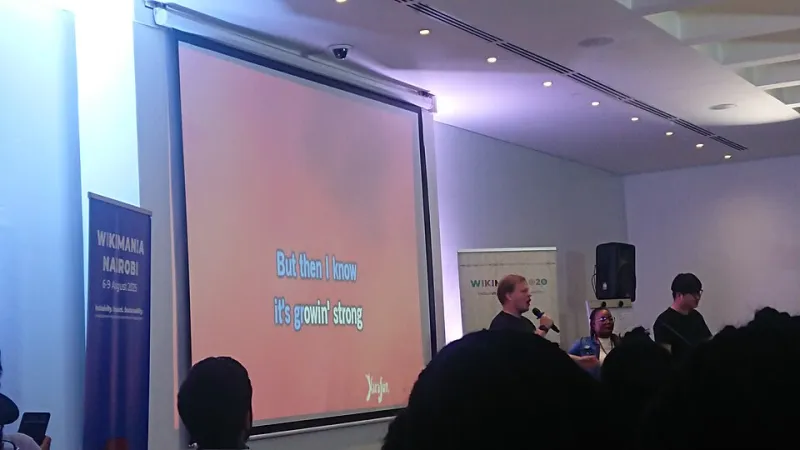
Photo: Byera04, CC BY 4.0, via Wikimedia Commons
Picture the scene: it's 11:30 on a Friday at your neighborhood dive, the karaoke host has that tired smile of a man who's heard 'Sweet Caroline' forty-seven times this month, and somebody in your crew — let's call him Doug — has just signed up for 'Word Up!' by Cameo.
Doug is a nice guy. Doug sings at church. Doug has watched the YouTube video twice.
Doug is about to have a very bad night.
The Problem With Singing Funk Out Loud
Here's the thing nobody tells you until you're standing in front of a bar full of strangers: funk is the only major American genre that actively resists being sung by normal humans. Rock hands you three chords and a grievance. Country hands you a story and a vowel. Hip-hop hands you somebody else's words and dares you to keep up. But funk? Funk hands you a talkbox, a two-note chorus, and a horn section you cannot legally reproduce with your mouth.
It's not an accident. Funk was never designed for the audience's throat — it was designed for the audience's feet. James Brown didn't shout 'Get up!' because it was lyrical poetry; he shouted it because he needed you to get up, and a sentence with a comma in it would've slowed the whole operation down. The genre traded narrative for propulsion, and somewhere in that trade, singability got left on the curb.
So naturally, we had to find out which funk song is the absolute worst one to attempt in public. We assembled a bracket. We suffered. You benefit.
The Bracket of Shame: Round-by-Round
The Play-In: 'Word Up!' — Cameo. The opening is a trap. It sounds conversational, almost easy, like you're just telling a story. Then Larry Blackmon hits that vocal register — part croon, part taunt — and Doug discovers his range has a ceiling. Every karaoke version of this song sounds like a man asking a question he doesn't know the answer to. Eliminated, but with dignity.
Quarterfinal: 'Give It to Me Baby' — Rick James. You'd think this one's doable. It's basically shouting. But the song is a sprint, and by the second chorus Doug is doing breathing exercises mid-verse like a woman in a Lamaze class. Rick James had the lung capacity of a man who never once sat down in 1981. You do not. Eliminated on stamina.
Quarterfinal: 'Brick House' — The Commodores. The female key is a gift to humanity, but the funk-wailing ad-libs in the final minute — that 'owww' that Lionel Richie does like he's being gently electrocuted — cannot be faked. We watched a man attempt it. We will not describe what we heard. Eliminated on ad-libs.
Semifinal: 'Super Freak' — Rick James (again). The verses are fine! The verses are honestly fine! And then the 'she's a very kinky girrrrl' run comes in, and every karaoke singer in America makes the same face: the face of a person watching their own confidence leave their body in real time. Eliminated on the bridge.
Semifinal: 'Flash Light' — Parliament. And here we arrive at the genre's final boss. Bootsy's bassline is a synth. The vocal is a talkbox. The chorus is the word 'Flashlight' repeated like a mantra, which sounds like a gimme until you realize that singing a talkbox part with a human mouth is like doing an impression of a fax machine with your feelings. There is no correct way to perform this song at karaoke. There is only the attempt, and the aftermath. Eliminated, then brought back, then eliminated again for dramatic effect.
The Champion of Un-Singability
After much debate, one bottle of store-brand sparkling grape juice, and a tiebreaker vote that ended a friendship temporarily, we crowned 'Flash Light' the most un-karaokeable funk song in American history.
And honestly? That's the trophy Parliament should want. Because here's the deeper truth: funk's un-singability is its whole survival mechanism.
Why a Song You Can't Sing Is a Song You Have to Dance To
Think about the genres that dominate karaoke night. They're all, at their core, spectator-friendly. You can sit and listen to a power ballad. You can nod along to an acoustic guitar. Karaoke thrives on songs built for watching — songs where the singer is the show and everyone else is the audience.
Funk refuses that arrangement. When the chorus is one word, when the vocal is a robot, when the most memorable line of the song is a synth bassline doing something no human larynx can imitate, there is nothing left to watch. There is no star to spectate. There is only the floor, and your body, and the four-count that's been holding American dance music together since before you were born.
That's why funk never really died, and why it keeps coming back — in roller rinks, in weddings, in the extended 12-inch cuts DJs hoard like dragon treasure. You can't consume funk passively. It doesn't have a spectator mode. It only has a participation mode, and participation means moving.
So the next time Doug grabs the mic and cues up 'Word Up!,' don't save him. Let him fail magnificently. Let the whole bar learn the lesson funk has been teaching since 1965: this music was never meant to be sung. It was meant to be surrendered to.
And then, when the karaoke host mercifully kills the mic and the DJ drops something with a real bassline — that's your cue. Get up. Get into it. Get involved.
You know. Like the man said.