Mouth Full of Wires: The Talkbox, Zapp's Robot Choir, and Why Your Favorite Rappers Still Borrow a Dayton Legend's Throat
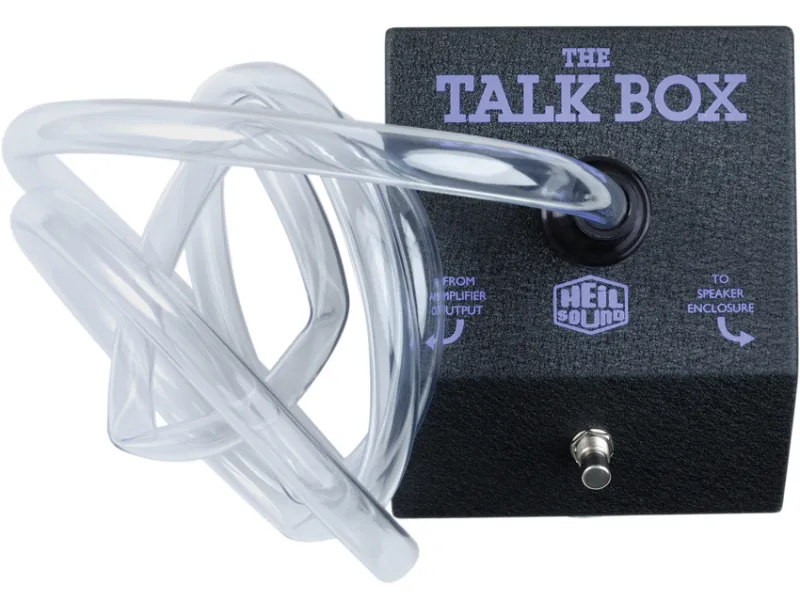
Photo: talkbox guitar pedal tube vintage funk recording studio, via cdn.mos.cms.futurecdn.net
Every few years, somebody declares the talkbox a novelty — a gimmick, a party trick, the musical equivalent of a lava lamp. And every few years, the talkbox responds by showing up on a multi-platinum record and making the lava lamp comparison look even sillier than it already was.
The latest wave is easy to hear. Travis Scott warps his voice into something alien. Bruno Mars tips his fedora to the West Coast boogie canon. Snoop built entire eras off a sound that, whether he says it or not, owes a royalty check to a guy from Ohio with a tube in his mouth. That sound has a name, a history, and a hometown — and if you claim to love funk, you should know all three.
Wait, Isn't That Just Autotune? (No. Please.)
Let's clear this up before we go any further, because confusing the talkbox with Auto-Tune is the fastest way to get escorted out of a funk night.
Auto-Tune is software. It corrects your pitch after the fact. The talkbox is a small amplifier with a plastic tube routed to your mouth. The instrument's signal travels up the tube, and you shape the sound with your own lips, tongue, and jaw — mouthing the words as the machine speaks through you. It is, quite literally, a human-machine duet. The robot doesn't sing for you. You sing for the robot.
The effect is unmistakable: vowels that sound like they're underwater, consonants that crackle like a arcade cabinet, a voice that seems to be grinning even when it can't technically have a mouth.
The Dayton Sound
The talkbox existed before Roger Troutman — pedal steel players dabbling in the '60s get some credit — but nobody played it like Roger. Fronting Zapp with his brothers in Dayton, Ohio, he turned the talkbox from an effect into a lead vocalist. Not a garnish. The entrée.
Then came "Computer Love" in 1985, with Charlie Wilson and the Gap Band riding shotgun. That record didn't just chart; it became infrastructure. Dr. Dre, Tupac, Snoop — the West Coast rap boom of the '90s was built, in part, on sampling Zapp and Roger like it was a public utility. "So Ruff, So Tuff," "More Bounce to the Ounce," "I Want to Be Your Man": these tracks have been flipped so many times they're practically genre-neutral real estate.
Roger's death in 1999 was a genuine loss, but the sound refused to retire. It just changed hands.
The Producers Keeping the Tube Lit
Talk to working producers today and a pattern emerges: the talkbox survived because it does something software can't fake — imperfection.
A vocoder is clean. A talkbox is messy. Every syllable wobbles differently depending on how the player's mouth is feeling that night. Modern producers chasing warmth and character — the same reason vinyl sales keep climbing — reach for the box precisely because it misbehaves. You can't quantize a tongue.
There's also the performance factor. A talkbox player at a show is a spectacle: hunched over the rig, tube clenched in teeth, hands flying across the keys while the robot voice answers back. In an era when half the stage is a laptop, that's showmanship you can't download.
Crate-Digging Corner: Start Here
If you want to hear the source material — and you should — the Zapp catalog is still cheap, deep, and glorious. Our picks:
- Zapp (1980) — "More Bounce to the Ounce" is the thesis statement. Find the 12-inch if you can.
- Zapp II (1982) — "Computer Love." Enough said.
- Roger, The Many Facets of Roger (1981) — "I Want to Be Your Man" proves the box could do slow jams, not just bounce.
- Zapp III (1983) — Deeper cuts, hotter grooves, criminally underpriced in most bins.
Original Warner Bros. pressings turn up in dollar crates and dollar bins more often than they should, which is either a market failure or a gift. We call it a gift.
The Punchline
Boogie never died. It didn't even go out of style — it just took a job in pop music, changed its mailing address, and learned some new software. But peel back the plug-ins on half of today's biggest records and you'll find that watery, joyful, unmistakably human robot voice, still talking through a plastic tube, still from Dayton.
The talkbox never left the party. Everyone else just caught up.