Four Speakers and the Truth: Why the Car Was Always Funk's Loudest Venue
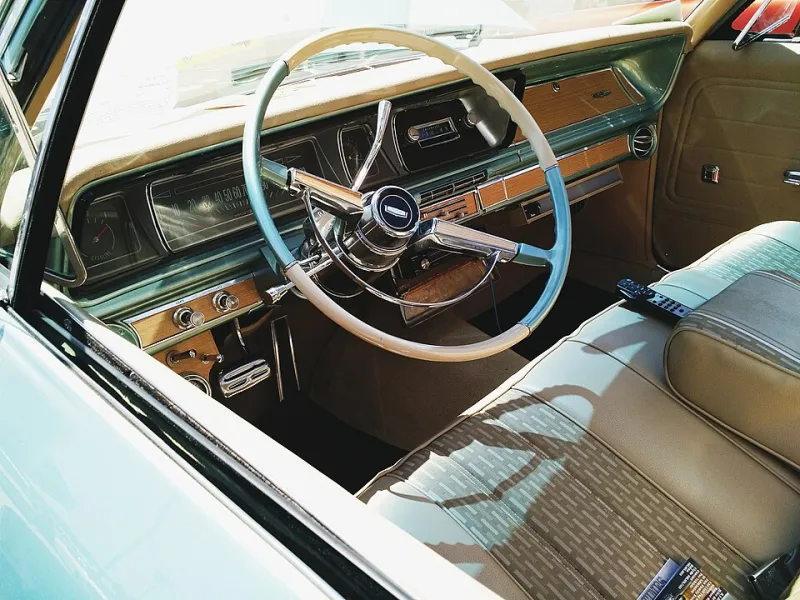
Photo: Ryan Tauss ryantauss, CC0, via Wikimedia Commons
There's a moment every funk fan of a certain age knows by heart: you're doing 65 on some two-lane blacktop, the tape deck is doing its best impression of a garbage disposal, and the bassline from 'Flash Light' comes through four dashboard speakers like it was mixed specifically for your Oldsmobile. Which, in a way, it was.
We talk a lot about dance floors around here. But ask anyone who came of age between 1965 and 1995 where they actually heard the music — really heard it, learned it, memorized the horn stabs — and the answer is usually behind a steering wheel.
The Dashboard Was the First Portable Sound System
Think about the logistics of funk for a second. This is a music built on low end, on basslines that walk into the room before the rest of the band does. Home hi-fis in the '70s? Lovely for a B-52s record, hopeless for Bootsy. Living room speakers of the era simply folded up and surrendered below 80 hertz.
Car audio, weirdly, did not. Automakers chasing the youth market started bolting increasingly ambitious sound systems into family sedans, and aftermarket shops from Detroit to Houston figured out that a car's cabin was basically a sealed bass cabinet on wheels. The very physics that made your living room hi-fi flabby made your Cutlass thump.
The 8-track came first, naturally. It was clunky, it ate tapes, and it had a pause between tracks long enough to make small talk. Nobody cared. The moment a teenager could choose what played in the car — not whatever the AM dial decided — the dashboard became a venue. And funk, being the road-trippiest music ever committed to tape, moved in and never left.
Dubbing Rights: The Mixtape Economy
Here's where it gets beautiful. Recording songs off the radio onto a blank cassette was a legal gray area and a moral imperative. Every kid with a boombox pressed 'record' the second a WKYS or KDAY DJ cued up the Ohio Players, and prayed the disc jockey didn't talk over the intro.
Those cassettes circulated like currency. Your cousin in Atlanta dubbed you a tape of stuff that hadn't hit your local radio yet. A friend's older brother worked at a record store and made 'special editions.' The car became the listening room for an entire shadow distribution network — the pre-digital version of a DJ sending you a playlist at 2 a.m.
We called up Marv Denson, 71, who ran a car stereo shop outside Oakland for three decades. 'Half my customers weren't buying speakers,' he told us. 'They were buying volume. They'd bring in a tape their boy made, and I'd tune the system until that tape sounded like a hit record. Didn't matter if the recording was third-generation. Funk don't care about fidelity. Funk cares about push.'
The Boom Car Era: Rattling Windows, Polite Neighbors
By the late '80s, the arms race went nuclear. Subwoofers the size of truck tires. Amps drawing enough current to dim the headlights. The boom car was born, and along with it a whole civic ritual: the two kids at a red light whose trunk is audibly renegotiating the terms of their suspension.
Was it obnoxious? Absolutely. Was it also the reason an entire generation knows every note of 'Tonight' by Kleeer or 'You Dropped a Bomb on Me'? Also yes. The boom car was funk's last great public venue — you couldn't NOT hear it, which, if we're honest, is the entire point of funk going all the way back to James Brown demanding the band play like the building's on fire.
The Playlist: Built for the Interstate
Not every funk record survives the dashboard. Some are too dense, too studio-crafted, too dependent on hearing the shaker in the left channel. These don't. These were practically written at 70 miles an hour:
- 'Flash Light' — Parliament. The synth bass was designed to sound like a foghorn. Foghorns belong on highways.
- 'Get Off' — Foxy. That bassline is a speed limit violation waiting to happen.
- 'Give Me the Night' — George Benson. For when the sun's going down and you're not in a hurry anymore.
- 'Word Up!' — Cameo. Sounds fine on earbuds. Sounds like a civic event through four speakers.
- 'Fire' — Ohio Players. The horn section was engineered to rattle trim pieces. We don't make the rules.
- 'I Should Be Dancin'' — Brainstorm. The breakdown at the two-minute mark was built for merging onto a freeway.
- 'Don't Stop the Music' — Yarbrough & Peoples. Dallas boogie that sounds like an open road feels.
- 'Ain't We Funkin' Now' — The Brothers Johnson. Six minutes of low end. Bring a spare alternator.
The Vinyl Angle: Why You Should Still Hunt the Cassette
Here at Drop the Boogie, we're crate diggers at heart, and we'll let you in on something: the used cassette market is the last honest bargain in music collecting. Funk cassettes from the era — Motown-era compilations, sunshine funk regional pressings, radio-station promo dubs — sit in dollar bins at flea markets from Flint to Fresno, largely ignored while everyone fights over the vinyl.
Do they sound better than vinyl? No. Do they sound correct in a car, with a little tape hiss like highway noise baked in? We'd argue yes. And a working dash deck with a genuine dubbed cassette in it is the most stylish flex the interstate has ever seen.
So the next time some streaming service promises you a 'funk for the drive' algorithm playlist, pour one out for the 8-track that ate itself in 1978, the dub your cousin made you in 1986, and the boom car that woke up an entire zip code — all in service of the one American art form that was never happier than when it was rattling somebody's rearview mirror.